
- 20+ years professional development
- Elgin-based, working UK-wide
- Fixed-price proposals
- 90-day managed launch care
- PageSpeed 80+ on every build
- UK company & ICO-registered
- Cloudflare-protected
- Stripe secure payments
Why connect your tools?
Why connect your tools?
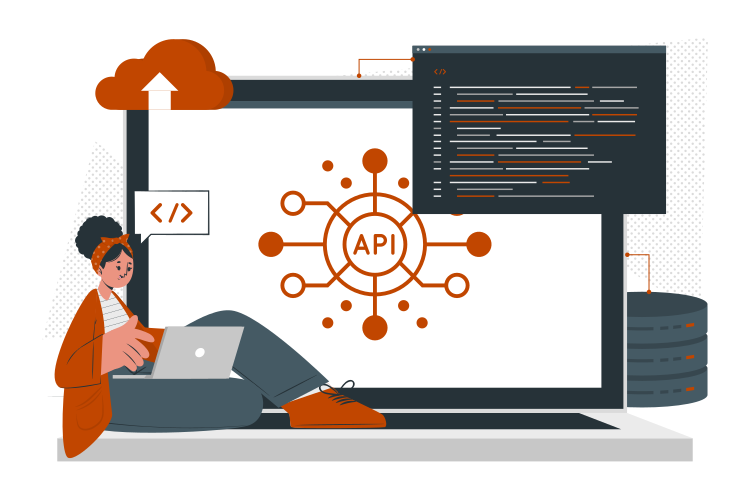
Your business tools should talk to each other automatically. We build that on an outbox pattern — the write and the notification happen in the same transaction, so a failed step can’t silently lose an order.
- Connect systems so they share data automatically
- Automate workflows that currently require manual steps
- Secure connections with no exposed passwords
- Built to grow as you add new tools
What we handle
Connecting two systems once is easy. The parts below are what decide whether it keeps working — usually invisible until something goes wrong.
Authentication & access
OAuth flows, API key rotation, and service-to-service authentication — credentials are never hard-coded and never sit exposed in your codebase.
Retries & idempotency
A failed request is retried safely — without double-charging a customer or double-creating an order — and rate limits are respected instead of triggering a ban.
Webhooks & real-time events
Incoming webhooks are signature-verified and handled safely if they arrive twice, arrive out of order, or don’t arrive at all — polling as a fallback where that matters.
Monitoring & alerting
If an integration starts failing, we find out from a monitoring alert — not from you, and not from your customer.

Popular use cases
- Mailchimp, SendGrid, or SMTP integrations
- Stripe or PayPal payment flows
- CRM integrations (HubSpot, Zoho, Capsule)
- WhatsApp, SMS, or chat integration via APIs

What this looks like in practice
A typical example: an order comes in through your website, gets pushed straight into your accounting software as an invoice, triggers a confirmation email, and updates stock levels — all without anyone re-typing anything.
If your accounting software is briefly unreachable, the order isn’t lost — it retries automatically, and you’d only hear about it if it genuinely couldn’t recover.
Splitting up a large system, or scaling past what one integration handles?
Breaking a monolith into services, background job processing at scale, and event-driven architecture live on our Distributed Systems page.
Tell us what needs to talk to what.
We’ll find the right approach — and tell you honestly if it’s simpler than you think.
Get in touch